Sealing a Railway variable takes away every way a person can read it back. It takes away none of the ways your code uses it. The dashboard row turns into dots, and the build and the running service carry on receiving the same plaintext they always did.
That gap is fine as long as you know it is there. It bites when the dots get read as "this secret is safe now", which is what the dashboard visually suggests.
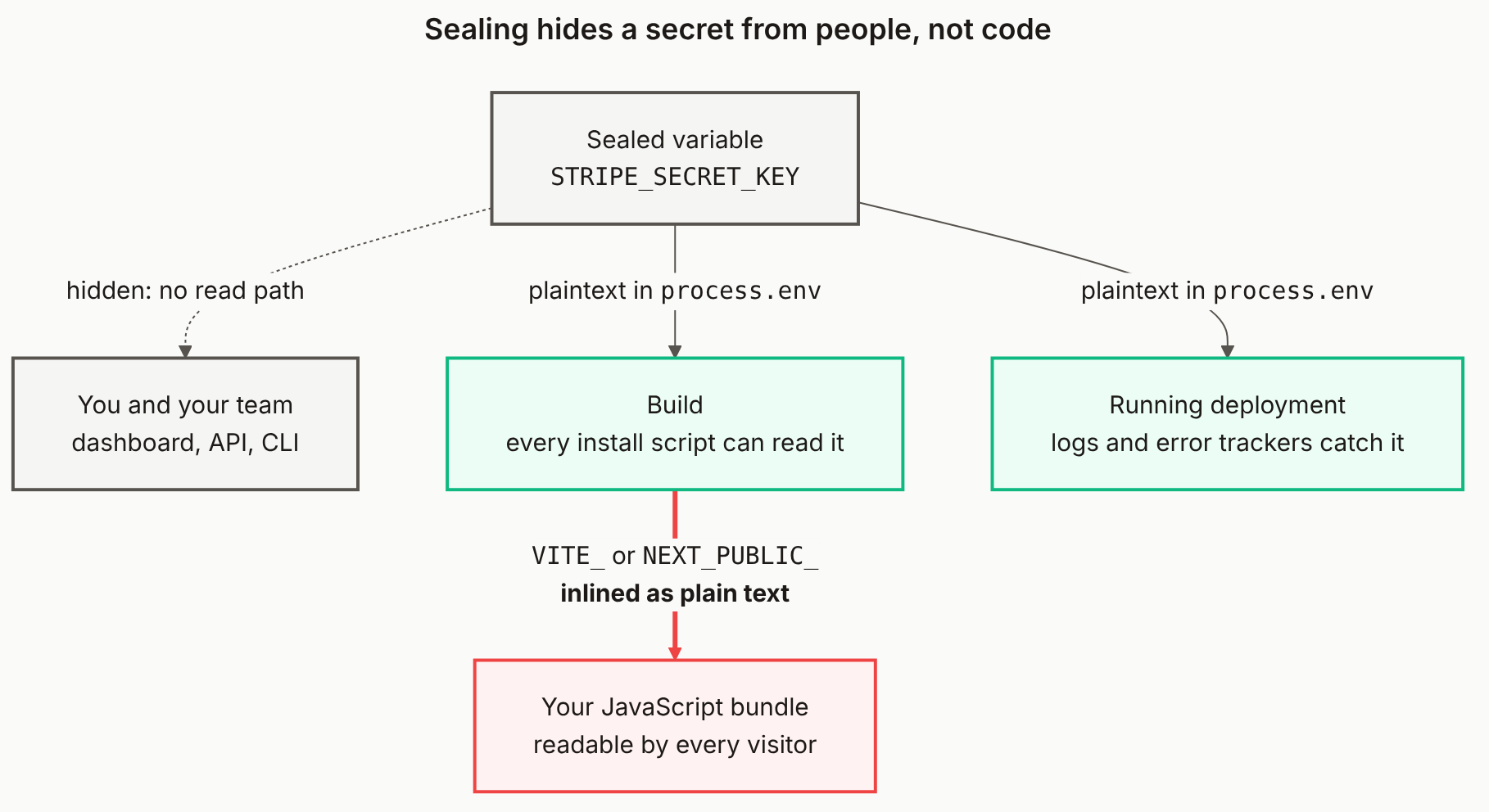
Reading the diagram
Start at the grey box at the top. It is one sealed variable, STRIPE_SECRET_KEY, and every arrow below it is a place the value can or cannot go.
Left, dotted: you and your team. This is the only path sealing cuts. Railway's docs put it as a value that "is never visible in the UI nor can it be retrieved via the API", and the CLI will not print it either. The line is dotted because nothing crosses it. It is also grey rather than green, because blocking a person is not the same as protecting the value: the people on your team were never the main way a key escapes.
Middle: the build. The value arrives as plaintext in process.env, because Railway injects sealed variables into builds. While the build runs, so does npm install, and that runs every postinstall script in your dependency tree as ordinary code. Green here means server-side, out of a visitor's reach, not out of a compromised package's reach.
Right: the running deployment. Same plaintext, same process.env. Sealing does not touch what your code does with it next, so a console.log(process.env) or an error tracker that attaches environment context will write the value somewhere else, under somebody else's retention policy.
Bottom, the red edge: your JavaScript bundle. This is the one that turns a server-side secret into a public one. If the variable's name starts with VITE_ or NEXT_PUBLIC_, the bundler copies the value into the client files at build time. Every visitor downloads it. The box is red because anyone can read it, and the edge is the only emphasised one because it is the mistake that costs money.
A sealed public-prefixed variable is the worst case. It is invisible to you in the dashboard and visible to everyone in the browser, so the one place you would notice it is the one place it no longer shows.
What to do with it
Seal live credentials anyway. Closing the read-back path is worth it. Then handle the other three arrows yourself: keep credentials the build does not need off the build side, keep process.env out of log and error calls, and never give a secret a VITE_ or NEXT_PUBLIC_ name. The full walkthrough, including a one-line bundle check, is in Railway Secrets: How Sealed Variables Work and What They Miss.
The Mermaid source
Copy this and swap in your own variable name.
---
title: "Sealing hides a secret from people, not code"
---
flowchart TB
    V["Sealed variable<br/><code>STRIPE_SECRET_KEY</code>"]

    H["You and your team<br/>dashboard, API, CLI"]
    B["Build<br/>every install script can read it"]
    R["Running deployment<br/>logs and error trackers catch it"]

    J["Your JavaScript bundle<br/>readable by every visitor"]

    V -.->|"hidden: no read path"| H
    V -->|"plaintext in <code>process.env</code>"| B
    V -->|"plaintext in <code>process.env</code>"| R
    B -->|"<code>VITE_</code> or <code>NEXT_PUBLIC_</code><br/><b>inlined as plain text</b>"| J

    classDef private fill:#ecfdf5,stroke:#10b981,stroke-width:2px,color:#1c1917
    classDef public fill:#fef2f2,stroke:#ef4444,stroke-width:2px,color:#1c1917
    classDef store fill:#f5f5f4,stroke:#57534e,stroke-width:2px,color:#1c1917

    class V,H store
    class B,R private
    class J public

    linkStyle 3 stroke:#ef4444,stroke-width:3px
Does a sealed Railway variable reach my build?
Yes. Railway's docs say a sealed value is provided to builds and deployments. Sealing only removes it from the dashboard, the API and the CLI, so during the build it is a plain string in process.env like any other variable.
Can a dependency read a sealed variable?
Yes, if the variable exists while that dependency's code runs. npm install executes postinstall scripts from your whole dependency tree during the build, and they read process.env like your own code does. Keep credentials the build does not need off the build side.
Is a sealed NEXT_PUBLIC_ or VITE_ variable private?
No. Those prefixes tell Next.js and Vite to write the value into the client JavaScript at build time. The dashboard shows dots and the bundle shows the key, readable by anyone with view-source.
What does sealing actually protect against?
A person reading the value back: a teammate in the dashboard, a script calling the Railway API, a screenshot of the Variables tab. That is a real leak path and worth closing for live credentials. It is just the only one sealing closes.
Did a sealed key end up in your bundle?
A scan reads your live site the way a visitor would and flags credentials it finds in the JavaScript, sealed or not.